Costa Rica Visa & Entry Requirements (2026)

In this guide
- Do you need a visa for Costa Rica?
- The requirements at a glance
- Costa Rica digital arrival card and health form
- Passport validity: no six-month rule
- The onward ticket
- Proof of funds: US$100 a month
- How long you actually get
- The exit tax: US$29, usually already paid
- Yellow fever, and only yellow fever
- Money, customs and leaving again
- A week-before checklist
US travelers do not need a visa for Costa Rica. The US State Department says a visa is not required for stays of less than 180 days, and that a return ticket is required. The Embassy of Costa Rica in Washington says the same: US nationals do not require an entry visa, and as tourists they cannot stay more than 180 days.
That 180 days is a ceiling, not a promise. The State Department says authorities may allow a stay of up to 180 days without a visa, but this is not guaranteed. The immigration officer decides the number, and you have to leave by the date you were given.
You still need a passport that covers the stay and a ticket out. There is no separate digital arrival card to file before you fly. The details, and the sources, are below.
These rules were checked on 14 November 2026 against the State Department’s Costa Rica page (guidance dated 4 September 2026), the Embassy of Costa Rica, the Costa Rica Tourism Board, and Costa Rica’s visa guidelines AJ-484-11-2025, issued by the Dirección General de Migración y Extranjería and published in La Gaceta on 17 November 2025.
Do you need a visa for Costa Rica?
No. A US passport does not need a tourist visa for a stay under 180 days. Admission is still the immigration officer’s decision. The embassy says entry depends on that officer, the same way it does at a US airport.
The November 2025 guidelines sort countries into four groups. The United States is in the first group:
- Entry without a visa.
- Maximum stay of up to 180 calendar days, and that period is not extendable.
- The only extension the guidelines allow is narrow: if the officer grants you fewer than 90 days, the stay can be extended only up to 90 days, not up to 180.
- Passport valid for at least one day on the day you enter. The stay the officer grants cannot run past the passport’s expiry.
The same first group, in that document, includes Canada, the United Kingdom, the European Union countries, Iceland, Liechtenstein, Norway, Switzerland, Australia, New Zealand, Mexico and Panama. Honduran citizens are in the second group: no visa, a maximum of 30 days, and from age 18 a police certificate from Honduras. Costa Rica is not one of the four CA-4 countries (Honduras, Guatemala, El Salvador and Nicaragua). If your passport is not in the first group, read the guidelines or ask a Costa Rican consulate before you book.
The guidelines also limit what a tourist stay is for. People admitted as tourists may rest, do business or do professional activities, as long as they are not paid for work inside Costa Rica. A job, a study program or a stay past 180 days is a different process, handled by Migración, not by the tourist rule on this page.
The requirements at a glance
| Requirement | What the official sources say |
|---|---|
| Tourist visa, US passport | Not required for stays under 180 days |
| Maximum stay | Up to 180 calendar days, set by the officer, not guaranteed |
| Extension | Only if you were given under 90 days, and only up to 90 days total |
| Passport validity | Valid for the stay; Group 1 minimum is one day on entry |
| Passport condition | Machine-readable or biometric, and in good condition. A damaged passport can be refused |
| Onward travel | Return or onward ticket required |
| Proof of funds | At least US$100 per month, or part of a month, of the legal stay |
| Digital arrival card | Not required |
| Health form | Not required. The COVID Health Pass was repealed on 1 April 2022 |
| Vaccinations | Yellow fever only, if you are arriving from a listed risk country |
| Cash | US$10,000 maximum on entry and on exit, then declare |
| Exit tax | US$29, included in most airline tickets since 2016 |
Costa Rica digital arrival card and health form
You can board for Costa Rica without filing an online arrival card or a health form. People searching for a “Costa Rica digital arrival card” are usually looking for the kind of pre-travel form other countries use, or for the COVID Health Pass (Pase de Salud). Costa Rica’s current entry lists do not include either.
What the official entry lists actually contain:
- The November 2025 guidelines say a foreigner must present a valid passport in good condition, a visa only when the guidelines require one, proof of funds, and a return or onward ticket, and must not be barred from entry. An online arrival card is not on that list.
- The US State Department’s entry list, in guidance dated 4 September 2026, is a passport, a return or onward ticket, yellow fever proof when it applies, and, for non-US citizens coming from the United States and going back there, documents that prove they can re-enter the US. No digital form.
- The Costa Rica Tourism Board’s entry page repeats the passport, visa-if-required, funds and ticket. It does not tell visitors to file an arrival card.
- The tourism board’s 1 April 2022 update repealed the temporary COVID entry measures, including the epidemiological form known as the Health Pass, and the medical-insurance rule for unvaccinated visitors.
A website that charges you to “submit your Costa Rica digital arrival card” is not the Costa Rican government. If Migración later publishes a real form, it will be on migracion.go.cr. Do not pay a third party for one in the meantime.
Passport validity: no six-month rule
Most of Latin America asks for six months of passport validity. For a US passport, Costa Rica does not.
The State Department’s requirement is that the passport must be valid for the period of the stay, and that immigration may deny entry if it is damaged. The embassy’s English page is more specific: a US passport must be valid for a minimum of one day from the day you enter. The November 2025 guidelines use that same one-day floor for the whole first group, and add that the stay the officer grants will not be longer than the passport’s remaining validity.
So a passport that expires two months after your trip is fine for Costa Rica, as long as the officer’s stamp does not run past that expiry. It is not fine for a side trip. Nicaragua and Panama set their own rules, and a connection through another country can too.
The guidelines also say Costa Rica accepts only passports that are machine-readable or biometric, under ICAO standards, and that the document must be in good condition. A current US passport meets the machine-readable test. A water-stained or separating one is a separate problem, and leftover validity does not fix it.
The onward ticket
Both governments state it. The State Department lists “Return ticket or proof of onward travel to another country,” and summarises the visa line as “A visa is not required for stays less than 180 days. But a return ticket is required.” The embassy says US nationals need a current passport and a return ticket to exit Costa Rica within 180 days, either home or to another country.
The tourism board, citing the migration law, says the immigration officer will ask for the return ticket when you arrive. It also says an onward booking can be:
- a prepaid flight out of Costa Rica
- a prepaid bus ticket out of the country
- proof of a cruise passage
Hold that booking before you leave home, and make sure the date falls inside the stay you expect to be given. Travellers who plan to leave overland for Nicaragua or Panama with no ticket are the ones who get stuck at the airline counter. The carrier pays to fly back a refused passenger, so check-in staff ask before you have a boarding pass. That is a practical consequence of the rule, not a statistic anyone official publishes.
One more documentary rule is easy to miss. Non-US citizens who enter Costa Rica from the United States and will return there must show Costa Rican immigration a valid, unexpired visa or permanent resident card proving they can re-enter the US. The State Department says extension letters and re-entry permits from USCIS are not accepted. This includes people traveling with US citizens.
Proof of funds: US$100 a month
The November 2025 guidelines require proof of economic means of at least US$100 for each month, or part of a month, of the legal stay. The tourism board quotes the same figure from Article 42 of the General Migration Law (No. 8764) and Article 30 of the migration-control regulation (Decree 36769-G), and says the officer can ask you to show it.
The State Department’s entry list does not mention this. We are not going to guess how often officers ask, or which paper they prefer. The amount is in Costa Rica’s own guidelines. Have a way to show funds for the length of stay you plan to request.
How long you actually get
The 180 days is a ceiling. The embassy puts it as a limit: as a tourist, US nationals cannot stay more than 180 days, and a longer stay needs a residence permit. The State Department says the full 180 days is not guaranteed, and tells you to leave by the date you were given.
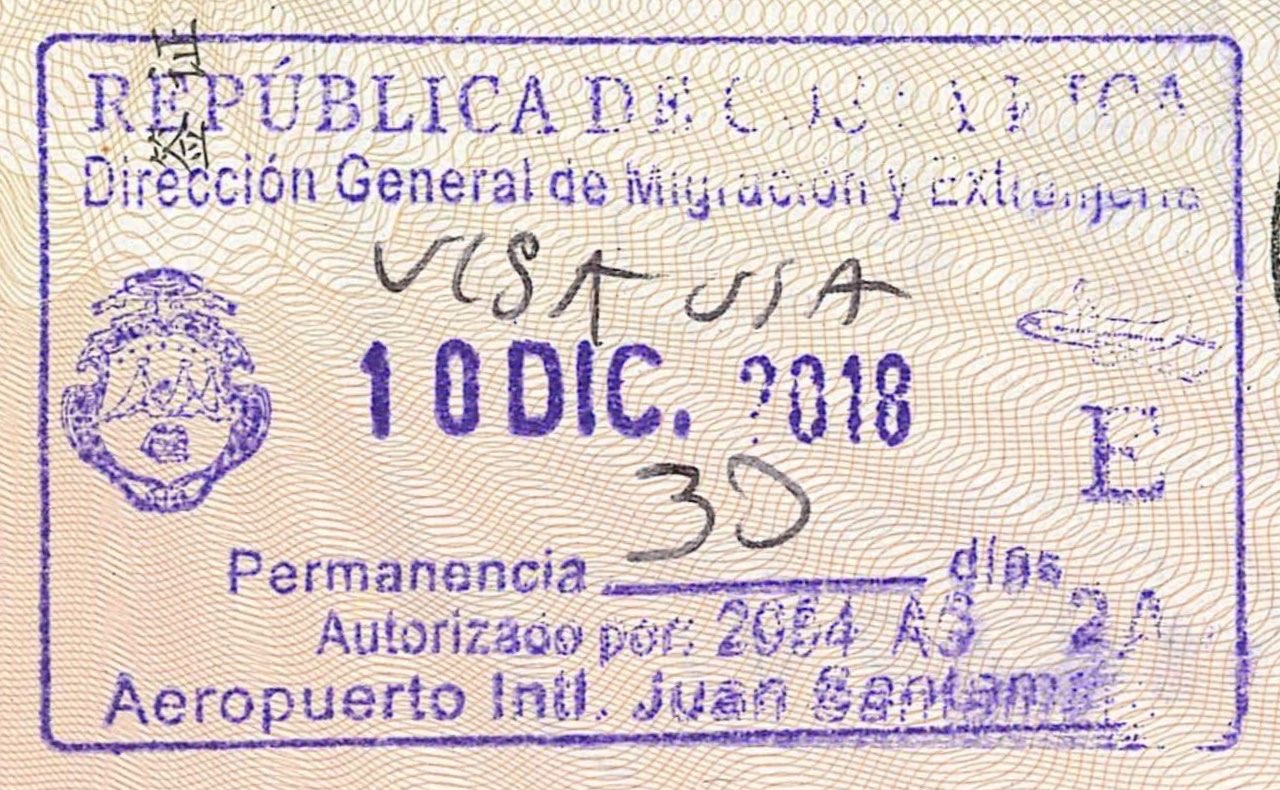
The tourism board says the officer can write a different period in your passport from the group maximum. On the entry stamp, that number is filled in by hand on the line that reads “Permanencia.” Read it before you leave the immigration hall. If it is shorter than your trip, that conversation happens there, not at the airport on the way out.
The extension rule is easy to misread, so here it is in the guidelines’ own shape. For the first group, the maximum is up to 180 calendar days and is not extendable. The parenthetical exception is the only one: an extension is available only to people who were granted fewer than 90 days, and only up to a maximum of 90 days. A 180-day stamp cannot be stretched. A 30-day stamp cannot be turned into 180. The guidelines we read do not spell out the application steps. For that, use migracion.go.cr or a Costa Rican consulate.
If you stay past the date you were given, the State Department says immigration could fine you, that you can face delays and deportation, and that you can be refused entry later. It does not publish the amount of the fine. The UK Foreign Office states a fine of US$100 for each month of overstay and says future applications can be refused. That dollar figure is the UK government’s statement. It is not repeated on the State Department page or in the November 2025 guidelines, so we are not presenting it as a number we confirmed in Costa Rican law.
The exit tax: US$29, usually already paid
Costa Rica charges a departure tax of US$29 per person. The tourism board’s airlines page says that since 2016 the tax has been included in most airline tickets, and that where a ticket states it does not include the departure tax, you pay US$29 in US dollars, in colones, or by credit or debit card. The board’s FAQ states the same US$29 figure.
| Situation | What you do |
|---|---|
| Tax included in your fare (most tickets) | Nothing at the airport |
| Ticket states the tax is not included | Pay US$29 per person before check-in |
| Unsure | Read the tax lines on the e-ticket, or ask the airline |
Paying by card at the airport has historically been processed as a cash advance by some issuers. If you know you have to pay, carry dollars or colones. The tourism board does not say children are exempt, so budget US$29 per person unless your own fare rules say otherwise.
Land borders are a separate question. We could not find an official amount for leaving Costa Rica overland to Nicaragua or Panama. Budget for a charge and confirm it at the crossing, rather than relying on a figure from a guide, including this one.

Both international airports use the same entry rules. Which one you fly into is an itinerary choice. Our Liberia vs San José airport guide covers that trade-off, and the San José airport guide covers arrivals at the main one.
Yellow fever, and only yellow fever
The State Department lists one vaccination: yellow fever, if you are arriving from certain countries in South America or Africa. The embassy names the countries it treats as a risk for people traveling to Costa Rica from South America or sub-Saharan Africa: Angola, Benin, Burkina Faso, Cameroon, the Democratic Republic of Congo, Gabon, Gambia, Ghana, Guinea, Liberia, Nigeria, Sierra Leone, Sudan, Bolivia, Brazil, Colombia, Ecuador, Peru, Guyana and Venezuela. You can enter ten days after the shot, and the proof is the International Certificate of Vaccination.
The embassy also lists exceptions, including people who spent at least six days in a non-risk country before entering and did not develop yellow fever, and medical contraindications such as age under nine months. Read that list on the embassy’s visa page if your route is close to the line. Transits can matter. The tourism board tells international visitors to check health rules against their country of origin, recent travel and layovers. Its 31 August 2026 yellow-fever note is about Costa Rican citizens and residents leaving for risk countries, which is a different direction and a slightly different country list. Do not treat that outbound list as the inbound rule.
A direct flight from the United States, with no recent travel in a listed country, does not trigger this.
Money, customs and leaving again
You may bring in or take out up to US$10,000. Above that, declare. The State Department lists the same ceiling on the way in and on the way out.
Two rules can stop you leaving:
- Debts. If you owe money in Costa Rica, authorities may not let you leave. The State Department names unpaid bills from car accidents and medical costs, and says child support can mean paying up to 13 months before you go. Settle a rental-car incident before your departure date. Our Costa Rica driving guide covers why a traffic accident there is a slow process.
- Children born in Costa Rica. They are Costa Rican citizens, and Costa Rican minors need an exit permit from immigration. The State Department says non-Costa-Rican minors who live in Costa Rica may be covered too, and that this is strictly enforced. It does not apply to a foreign child visiting on holiday. Any family with a Costa Rican-born child should check with immigration before traveling.
Carry copies of your identification and immigration papers. The State Department says local authorities may ask for your original passport and can detain you while they verify your identity and status.
A week-before checklist
- US passport, tourism, under 180 days: no visa to apply for. Other passports, check the November 2025 group list.
- Passport valid for the whole stay, at least one day on entry, and physically intact.
- Onward or return ticket dated inside the stay you expect, by air, prepaid bus or cruise.
- A way to show at least US$100 per month of that stay, if an officer asks.
- No digital arrival card and no Health Pass. Do not pay a site that sells one.
- Exit tax: confirm the US$29 is in your fare.
- Yellow fever certificate only if your route touches a listed country.
- On arrival, read the number on your stamp.
The entry requirements checker answers the visa question for the passports it covers, with the same official links. Once you are through the hall, the Costa Rica 10-day itinerary is the trip itself, and the best time to visit Costa Rica is when to take it.
Confirm the week you travel on the State Department’s Costa Rica page, the Embassy of Costa Rica (the Spanish page points at the latest guidelines), the November 2025 guidelines and the tourism board’s entry requirements. This site is not an immigration authority.
Frequently asked questions
Do US citizens need a visa for Costa Rica?
No. The US State Department says a visa is not required for stays of less than 180 days, and a return ticket is required. The Embassy of Costa Rica in Washington says the same: US nationals do not require an entry visa, cannot stay more than 180 days as tourists, and need a passport valid for at least one day on entry. Costa Rica's own November 2025 visa guidelines put the United States in the first group: entry without a visa, up to 180 calendar days, not extendable, except that a stay granted for fewer than 90 days can be extended only up to 90 days. The officer on arrival decides the actual number, and entry is not guaranteed.
How long can US travelers stay in Costa Rica?
Up to 180 calendar days, which is a maximum, not a promise. The State Department says authorities may allow a stay of up to 180 days without a visa, but that this is not guaranteed, and that you must leave by the date you were given. The number that binds you is the one the officer grants. If that number is under 90 days, the November 2025 guidelines allow an extension only up to 90 days total, not up to 180. A full 180-day grant cannot be lengthened. The State Department says an overstay can mean a fine, delays, deportation and a future refusal. It does not publish the fine. The UK Foreign Office states US$100 for each month; that figure is not in the State Department page or in the guidelines we read.
Does Costa Rica require a digital arrival card or health form?
No. The November 2025 visa guidelines list a passport, a visa only if your nationality needs one, proof of funds, and a return or onward ticket. They do not list an online arrival card. The Costa Rica Tourism Board's 1 April 2022 update repealed the COVID Health Pass, the old epidemiological form. The State Department's September 2026 entry list does not include a digital form either. Do not pay a website that sells a Costa Rica digital arrival card.
How long must my passport be valid for Costa Rica?
For US passports there is no six-month rule. The November 2025 guidelines, which place the United States in the first group, require the passport to be valid for at least one day on the day you enter, and they say the officer cannot grant a stay that runs past the passport's expiry. The State Department puts the same idea as: the passport must be valid for the period of the stay. A damaged passport can still be refused, and only a machine-readable or biometric passport is accepted.
Is proof of onward travel required for Costa Rica?
Yes. The State Department lists a return ticket or proof of onward travel. The Embassy of Costa Rica says US nationals need a return ticket to leave within 180 days, back home or onward to another country. The tourism board says the immigration officer asks for the return ticket on arrival, and that a prepaid flight, a prepaid bus ticket out of the country, or proof of a cruise passage can satisfy the onward-travel rule. Airlines also ask at check-in, because they pay to fly back a passenger who is refused.
Do I need to show proof of funds?
The November 2025 guidelines require proof of funds of at least US$100 for each month, or part of a month, of your legal stay. The tourism board repeats that figure and says an officer can ask to see it. The State Department's entry list does not mention it. The guidelines do not say which document counts, so do not treat a specific bank letter as a rule we verified.
Is there still an exit tax in Costa Rica?
Yes. The Costa Rica Tourism Board says the departure tax is US$29 per person. Since 2016 it has been included in most airline tickets. If your ticket states that the tax is not included, you pay US$29 in dollars, colones, or by credit or debit card. Check the tax lines on your own ticket.
Do I need any vaccinations for Costa Rica?
Yellow fever only, and only in specific cases. The State Department says proof is required if you are arriving from certain countries in South America or Africa. The Embassy of Costa Rica in Washington names the countries it treats as a risk and says you can enter ten days after the vaccination. There is no general vaccination requirement for a direct trip from the United States. The old COVID Health Pass is not in force.
Keep planning
- Is Costa Rica Safe? Crime, Driving and Beach Hazards
Is Costa Rica safe? The Level 2 advisory explained, where theft concentrates, rip currents and drowning, car break-ins, taxis, methanol and what to plan for.
Updated Oct 2026 - Best Time to Visit Costa Rica: Dry, Green and Shoulder Season
Best time to visit Costa Rica month by month: Pacific dry season dates, why the Caribbean is driest in September, and green season prices.
Updated Oct 2026 - Costa Rica in 10 Days: Volcano, Cloud Forest and Coast
A realistic 10-day Costa Rica itinerary — La Fortuna, Monteverde and Manuel Antonio — with honest drive times, official park fees and the booking rules.
Updated Oct 2026